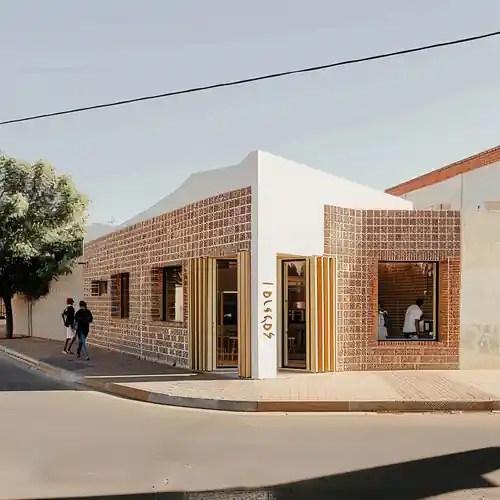
Modern Brick Two-Story House — Warang, Senegal

A two-story brick residence for a mid-altitude Cameroonian town — where the cool highland climate, rich red soils, and a growing middle class converge in a new domestic typology.

This two-story brick house study draws on that material tradition while proposing a contemporary spatial organization suited to the aspirations and lifestyle patterns of a modern Senegalese family.

The two-story section is economical: it doubles the accommodation without doubling the footprint, preserving garden space and reducing site coverage. A covered veranda at ground level extends the living area into the outdoor space, mediating between the interior and the street in a way that is culturally familiar and climatically appropriate.

Brick as Identity

Brick in this context is not merely a construction material — it is a statement of permanence and investment. The detailing of the façade — the proportions of openings, the treatment of the parapet, the choice of bond — become the primary expressive tools, transforming what could be a generic box into a building with character and presence in its neighbourhood.

These renders explore the residential architecture of Senegal’s Coastal towns — grounding the design in local climate, materials, and social patterns while reaching toward a contemporary expression of home.

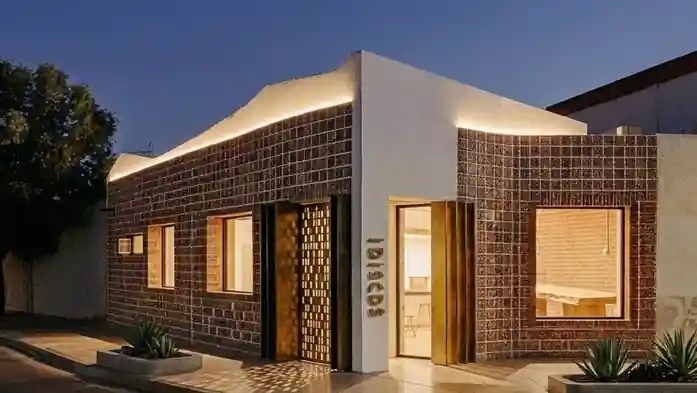
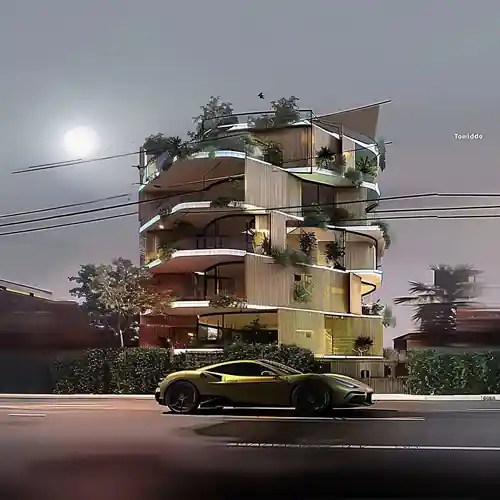
Nighttime Dakar — Design Brandscape

Dakar at night rendered through an architectural lens — exploring how light, shadow, and the city’s visual identity converge into a nocturnal brandscape.

The City After Dark

Dakar transforms at night. The harsh equatorial sun that flattens surfaces and bleaches colour during the day gives way to a rich nocturnal atmosphere — warm artificial light carving volumes out of darkness, the Atlantic horizon dissolving into blackness, and the city’s social life spilling onto streets and terraces in a way that daylight hours rarely allow.

This series of AI renders explores Dakar’s nighttime architectural character — what might be called its Design Brandscape. The term refers to the visual and spatial identity that a city projects through its built environment: the palette of its lights, the silhouettes of its buildings against the sky, the texture of its public realm when illuminated from below.

Light as Architecture

In tropical cities, architectural lighting carries particular weight — it extends usable hours outdoors, creates thermal gradients that drive natural ventilation, and defines the social geography of the street. These renders investigate how deliberate lighting design can reinforce a building’s character after sundown: emphasizing texture, directing movement, and signalling welcome.

These renders are speculative — architectural visions of what a consciously designed nocturnal identity for Dakar might look like. They are an invitation to think about the city not just as a daytime organism, but as a twenty-four-hour experience shaped by light, warmth, and the particular energy of West African urban life after dark.

Senegalese House — Water Details & Brick Façade

A deep dive into the material and atmospheric qualities of the Senegalese house typology — exploring water features, brick coursing, and the sensory language of West African domestic architecture.

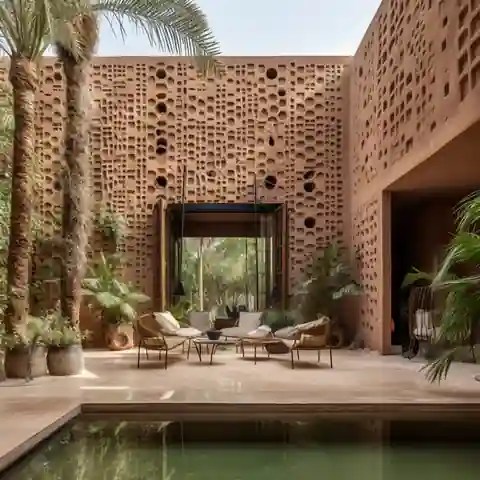
Water, Brick, and the Senegalese House

In the Senegalese residential tradition, water is more than utility — it is atmosphere. Courtyard fountains, reflecting pools, and channel features cool the air through evaporation, soften sound, and provide a focal point for domestic gathering. This series of AI renders investigates how water elements can be integrated into a contemporary Senegalese house without losing their poetic function.

Brick is the primary material protagonist here — hand-laid, sun-dried, or fired depending on regional availability. The coursing patterns speak to craft traditions that predate industrialization: herringbone, soldier course, and running bond each carry different visual rhythms that animate the facade across changing light conditions.

Atmospheric Architecture

The renders in this series focus on moments rather than floor plans — the play of shadow on a brick wall at midday, the reflection of sky in a still courtyard pool, the texture of a rendered arch worn smooth by years of hands. These are the sensory qualities that make a house a home, and they inform the spatial decisions made at every scale.

This collection represents an ongoing material investigation — using AI rendering as a tool for exploring the atmospheric and haptic qualities of architecture before any line is drawn on a construction document.

Ocean-Side Cigar Lounge & Humidor — Dakar, Senegal

An intimate ocean-side cigar lounge and humidor in Dakar — a boutique hospitality project where patterned brick, a private pool, and careful climate control combine to create a singular sensory experience.

A cigar lounge makes particular demands on architecture: it requires precise humidity control, excellent natural ventilation, a sense of privacy and enclosure, and an atmosphere that rewards slow, unhurried occupation. This ocean-side lounge and humidor in Dakar, Senegal answers all of those demands with a design that is elegant, purposeful, and beautifully situated.

The building uses the same patterned brick facade system seen in the broader Dakar portfolio — a perforated masonry screen that filters ocean breezes while maintaining the internal humidity conditions essential for a quality humidor. The courtyard and pool extend outward from the main lounge volume, giving guests a private outdoor space that captures sea views and the Dakar coastal light without fully exposing them to the elements.

The ground floor site layout organises the program efficiently: the lounge and humidor occupy the primary volume, with service and storage tucked to the rear. Structural details document the stilt-to-floor beam connections and enlarged brick module assembly — the same robust system that ensures long-term performance in a coastal salt-air environment.

Architectural Renders

Eco-Modular Retreat — Dakar, Senegal

A modular eco-retreat in Dakar, Senegal, where patterned brick facades and palm-lined courtyards create a series of private units that feel both contemporary and deeply rooted in their West African context.

The Eco-Modular Retreat in Dakar, Senegal is designed around a deceptively simple idea: that a retreat should feel like a community, not a compound. Multiple modular units are arranged around a shared central courtyard that contains a pool, mature palm plantings, and integrated rock fill areas — creating a landscaped heart to the development that every unit relates to and benefits from.

Each unit’s facade uses a patterned brick module that references traditional West African screens and lattice work, allowing light and air to move through while maintaining visual privacy. The brick pattern is not merely decorative — it is structural and functional, calibrated at the module level to achieve the right balance of openness and enclosure. Wood composite panels appear at deck surfaces, doors, and louvered elements, adding warmth to what might otherwise be a purely masonry composition.

The west elevation reads as a long, layered horizontal — a series of slightly staggered bays unified by a consistent roofline. A section through the pool and courtyard reveals the relationship between the units and the shared outdoor space, showing how the buildings frame, shelter, and overlook the communal area without dominating it.

Architectural Renders

Beachside Bar & Pergola — Dakar, Senegal

A relaxed beachside bar and pergola on the coast of Dakar — a hospitality structure built for the open air, with a timber canopy, ocean views, and the kind of design that makes every visit feel unhurried.

Some buildings are about enclosure. This one is about the opposite. The beachside bar and pergola in Dakar, Senegal is designed to dissolve the boundary between shelter and open sky, using a timber pergola structure to provide shade without walls — letting the breeze, the light, and the proximity of the ocean do the rest of the work.

The overall site plan shows the bar set within a larger landscaped area, with outdoor seating zones arranged around a circular feature that anchors the space and draws people in. The bar itself is long and well-stocked, with a service bar running behind the counter and a service hatch system that allows the kitchen to supply the space efficiently without disrupting the flow of service.

The pergola construction is fully documented: posts rise from concrete pad footings, a beam-and-rafter system spans between them, and detailed joinery connections are shown at each intersection. Sliding menu panels, serving hatches, and blue-toned upholstered seating complete the picture — a well-resolved commercial hospitality design that would be as comfortable at opening as it is after a decade of use.

Architectural Renders

Beachside surf club render

Exhibition Pavilion — Urban Site

A compact urban exhibition pavilion built around a dramatic tunnel passage — layering perforated screens, wood slat walls, and textured brick pavers to create a space that rewards careful attention.

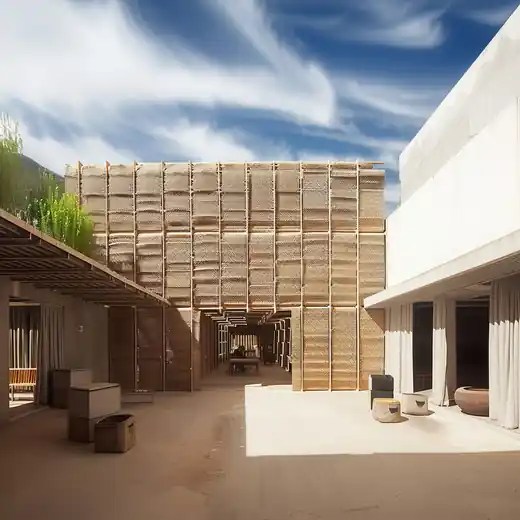
The best pavilions make a small site feel like a world of its own. This urban exhibition pavilion achieves that through a sequence of carefully layered thresholds: you approach across a paved forecourt, pass beneath a facade of perforated design screens, and enter through a tunnel passage whose compressed proportions make the interior feel expansive by contrast.

Inside, wood slat walls line the primary exhibition space, their rhythm creating a warm, directional backdrop for displayed work. The floor is concrete slab inlaid with red brick in a patterned bond, adding texture underfoot and reinforcing the sense that this is a considered, material-rich space. A service area runs along the rear of the plan, keeping operational functions discreet and out of sight.

The facade assembly is fully detailed: a structural frame sits behind an outer skin of perforated panels, with an insulation layer and wood block secondary screen between them — a wall that performs acoustically and thermally while doing significant architectural work on the street. Construction uses concrete slab foundations throughout, with structural framing that keeps the interior column-free for maximum flexibility.

Circular Earth Shelter with Rooftop Garden — Dakar, Senegal

An organic, circular-plan earth shelter in Dakar, Senegal, crowned with a productive green roof — a building that spirals inward like a living thing and gives back to the sky what it takes from the ground.

There are buildings that feel designed, and there are buildings that feel grown. This circular earth shelter in Dakar, Senegal, belongs to the second category. Its plan is radial and organic — a series of curved walls that spiral inward around a central core, creating rooms that flow into one another rather than sitting in a conventional grid.

The exterior walls use a combination of adobe clay, earth plaster, and rammed earth, chosen for their thermal performance, local availability, and the warm, textured surfaces they produce. The building is single-storey at its perimeter and rises toward its centre, culminating in a rooftop green roof assembly that supports planting, manages rainwater, and softens the building’s presence in the landscape.

Inside, the circular layout gives every room a curved wall — making spaces feel sheltered and particular rather than generic. The green roof assembly is fully detailed in the drawings, including its drainage layer, growing medium, and planting specification. This is a building that takes from the earth in its materials and gives back to it through its rooftop — a small, complete ecological cycle in built form.

Architectural Renders

Compact Timber Frame Cabin with Viewing Deck

A carefully crafted timber frame cabin with outbuilding and elevated viewing deck — a compact retreat where every square metre earns its place.

Small does not mean simple. This compact cabin proves that a modest footprint, when thoughtfully designed, can deliver comfort, character, and a genuine connection to its surroundings. The primary structure uses exposed timber framing — a warm, tactile system that gives the interior a sense of craft and honesty — with elevations that open generously to the views on three sides.

The ground floor plan organises all essential living functions efficiently: a main living area, kitchen, and bathroom within a compact form, with a covered outbuilding adjacent for storage or utility use. A separate viewing deck extends from the site, elevated to capture long views across the landscape — a simple addition that transforms the property’s relationship to its setting.

The longitudinal section reveals how the timber frame works structurally: paired rafters, a clear ridge beam, and carefully detailed wall-to-foundation connections that tie the building together without excess. This is architecture distilled to its essentials — a shelter that puts its occupants exactly where they want to be.

Residencia de Campo — Veracruz, Mexico

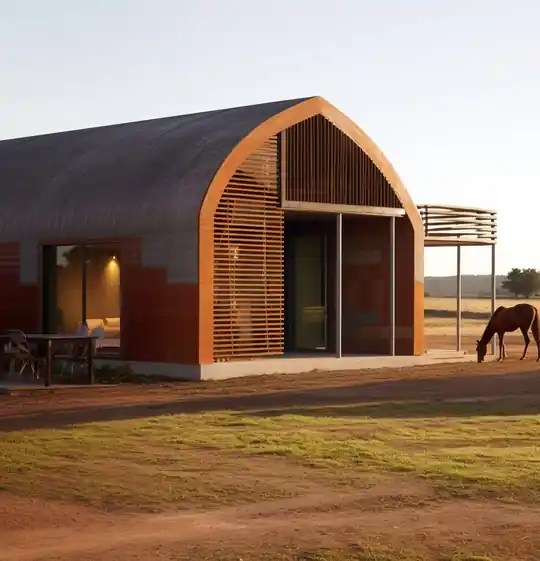
A rural country residence in Veracruz, Mexico, built with concrete blocks, corrugated metal roofing, and louvered wood screens — a working farmstead home designed as much for the land as for its inhabitants.

Sited on a working agricultural property in Veracruz, Mexico, this country residence (residencia de campo) is unpretentious and practical — a home designed to work hard alongside the people who live in it. The architecture responds honestly to its rural context: corrugated metal roofing keeps costs low and performs well in the local climate, while louvered wood screens (lamas de madera) shade the facade and encourage natural ventilation.

The floor plan is straightforward and livable: a salon anchors the social heart of the home, with a kitchen (cocina), bathroom (baño), and primary bedroom (dormitorio) arranged around it. Exterior wood decks extend from multiple sides of the house, connecting indoor life to the landscape and providing shaded outdoor working or gathering space.

Construction uses concrete block walls on reinforced concrete columns, founded on a concrete slab — robust materials that suit both the local building culture and the demands of a working ranch. A separate structure houses a horse trough (bebedero de caballos), a telling detail that locates this design firmly in its agricultural context.